Category: Case Studies
Date Posted : 08-Oct-2026
AI tools for churches turn the sermon you already preached into a week of content — video clips, devotionals, discussion guides, and posts — in hours instead of days. The audience is already there: Pew Research Center’s Religious Landscape Study finds 40% of U.S. adults participate in religious services at least monthly, in person or online , and separately, two in ten U.S. adults consume religious content through online videos on platforms like YouTube and TikTok. Your Sunday message is the richest content asset your church produces. This guide shows how to multiply it.
What Are AI Tools for Churches?
AI tools for churches, in the content context, are software that transforms existing ministry material — chiefly the weekly sermon — into new formats: transcripts, clips, quotes, emails, devotionals, and posts. The engine is the same across tools: transcription, summarization, and generation, applied to material your church already created.
That last clause carries the theology of this whole approach. The best church content strategy is not inventing content; it is stewarding the forty-five minutes of studied, prayed-over teaching you already deliver every week.
How Does Content Repurposing for Sermons Work?
Content repurposing for sermons works on a simple multiplication principle: one sermon becomes twenty or more pieces, each meeting a different person in a different scroll. A single Sunday message yields:

3–5 short vertical video clips of the strongest moments
5–7 quote graphics from the most shareable lines
A 5-day devotional series expanding the text day by day
A small-group discussion guide
A recap email and a blog post for digital outreach
A podcast episode from the cleaned audio
Pew’s data explains why the formats matter: 15% of U.S. adults listen to religion-focused podcasts and 30% search online for information about religion. Each format is a doorway; the message is the house.
Sermon to Video AI and Sermon Clips for Social Media
Sermon to video AI identifies the strongest 30–90 second moments in your recorded message, reframes them vertically, adds captions, and exports platform-ready clips. Sermon clips for social media consistently outperform full-service uploads for reach, because platforms distribute short native video to people who have never visited your page — including the unchurched neighbor your building will never reach first.
Three practices separate clips that minister from clips that merely exist: choose moments that stand alone without context, caption everything (most social video plays silently), and end with an invitation, not just a cut.
Choosing an AI Content Generator for Churches
An AI content generator for churches should be judged on voice fidelity first, volume second. The categories and their jobs:
| Content type | What the AI produces | Human role |
|---|---|---|
| Video clips | Moment selection, captions, vertical framing | Pick the moments that carry conviction |
| Quote graphics | Pull-quotes and layouts | Verify wording; approve theology out of context |
| Devotionals | Daily expansions of the sermon text | Edit for doctrine and pastoral tone |
| Emails and recaps | Summaries with next steps | Add the personal word only a pastor can |
| Discussion guides | Questions from the message | Tune to your groups’ actual maturity |
| Blog posts | Long-form adaptation of the transcript | Own every claim before it publishes |
The pattern in the right column is deliberate: generation is delegated, judgment never is.
Church Social Media Automation Without Losing Your Voice
Church social media automation earns its place when it schedules and distributes — and loses its way when it starts speaking as you. Automate the calendar: posting times, cross-platform distribution, recycling evergreen content. Keep human the conversation: replies, comments, and messages, where actual ministry happens.
A voice guide makes this practical. One page — your church’s tone, phrases you use, phrases you never use, how you talk about faith to outsiders — pasted into every AI prompt keeps a thousand generated drafts sounding like one shepherd rather than a content farm.
Social Media for Pastors: A Weekly Rhythm
Social media for pastors becomes sustainable when it runs on a rhythm rather than inspiration. A workable week, built from one sermon:
| Day | Content | Source |
|---|---|---|
| Monday | Sermon recap post + full podcast/video upload | Sunday’s message |
| Tuesday | Clip #1 + devotional day 1–2 | AI-extracted, pastor-approved |
| Wednesday | Quote graphic + small-group guide to leaders | Transcript |
| Thursday | Clip #2 + midweek encouragement email | Message + pastor’s note |
| Friday | Behind-the-scenes or team spotlight | Real life, not AI |
| Saturday | Invitation post for Sunday | Upcoming message |
| Sunday | Live moments, stories | The gathering itself |
Total pastor time under this rhythm: roughly two hours of review and approval weekly, because the generation is automated and the judgment is scheduled.
Should Churches Publish AI-Generated Religious Content?
Churches should publish AI-assisted religious content and should not publish AI-originated religious content — the distinction is authorship of the ideas. Repurposing your own preached sermon through AI keeps a human shepherd as the source of every idea; asking a model to originate devotionals from nothing makes the model the theologian.
Two rules make the line enforceable. First, provenance: every published piece traces back to teaching a human delivered. Second, review: a pastor or trained editor reads every piece before it posts, because AI-generated religious content can drift doctrinally in a single confident sentence. The efficiency is in generation; the integrity is in review. Keep both.
How to Automate Church Content End to End
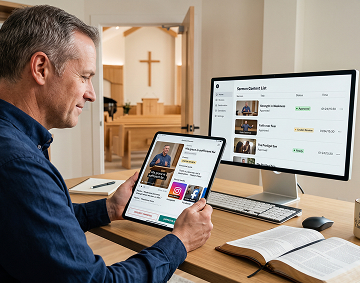
To automate church content end to end, build the pipeline once and run it weekly:
Capture well. Good audio recording of the sermon is the single highest-leverage investment.
Transcribe automatically. The transcript is the master asset every other piece derives from.
Generate the standard set. Clips, quotes, devotional, guide, email — same set every week, from templates carrying your voice guide.
Review in one sitting. A standing 60–90 minute Monday review slot for approval and edits.
Schedule and distribute. Automation posts across platforms on your rhythm.
Answer humanly. Replies and messages route to people — the same principle our AI church receptionist applies to the phone: automation opens the door, people do the ministry.
FAQs: Digital Outreach for Churches
What are the best AI content tools for churches on a small budget?
Start with two: an AI transcription/clipping tool for video and a general AI assistant (ChatGPT, Claude, or Gemini) with your voice guide for written pieces. That pair covers 80% of the pipeline for under $100 a month, and the sermon supplies the substance for free.
How does digital outreach for churches actually reach the unchurched?
Short native video travels beyond your followers: platforms show clips to non-followers based on engagement, which is how a sermon moment reaches someone who would never search for a church. Pew finds 30% of U.S. adults search online about religion — repurposed content is how your teaching is present when they do.
Can I automate church content without it feeling robotic?
Yes — automate production and distribution, never conversation, and keep one visibly human piece in the weekly mix. Congregations feel the difference between a church that uses tools and a feed that runs unattended; replies answered by real people are the tell.
Is AI-generated religious content theologically reliable?
Not by default. Models drift doctrinally and invent references with confidence, which is why the provenance rule (everything traces to human teaching) and the review rule (a pastor reads before it posts) are non-negotiable. AI assists the scribe’s work; it does not get the teacher’s chair.
How much time does church social media automation save?
Churches running the weekly rhythm above typically compress a 10–15 hour manual content week into roughly two hours of review — the generation, captioning, formatting, and scheduling layers are the automatable 80%. The saved hours, as with every tool we build, should flow back to people.
Multiply the Message
Your church already creates its best content every Sunday. AI tools for churches simply refuse to let it evaporate by Monday — one message, twenty doorways, and a congregation (and neighborhood) met where they actually scroll.
Missional Agents builds digital support staff so churches can multiply ministry without multiplying burnout — starting with the phone, where our AI receptionist answers every call as faithfully as your content now fills every feed. Explore AI for churches and start your 14-day free trial.
Related reading: how AI transforms sermon preparation itself — the upstream of everything in this post.