Category: Church Growth
Date Posted : 19-Aug-2026
AI for church administration automates the operational layer of ministry — calls, scheduling, correspondence, and coordination — so a lean staff runs like a larger one. The workload it targets is well documented: the median full-time senior pastor works 55 hours a week, and 42% work 60 or more, per Lifeway Research, with meetings and email eating hours that never appear in any ministry plan. This guide maps what is genuinely automatable in 2026, what it costs, and how to roll it out in 90 days.
What Is AI for Church Administration?
AI for church operations means software agents that complete administrative work — answering the phone, booking rooms, drafting correspondence, summarizing and routing requests — rather than software that merely stores information. A database remembers; an agent does.
That distinction is the 2026 shift. Churches have had management databases for decades. What is new is the layer that acts on top of them: conversational, rule-following, always on, and accountable to your policies.
Why Church Administration Automation Matters Now
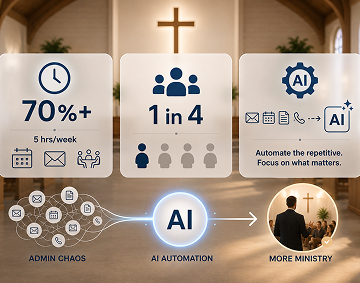
Church administration automation matters now because the operational load is a measured contributor to pastoral attrition. Lifeway’s workload study found more than 70% of pastors spend up to five hours weekly in meetings, and email consumes two to six hours weekly for half of them — on top of sermon preparation and care.
The attrition connection is direct: Barna reports that even after post-pandemic improvement, 24% of U.S. senior pastors seriously considered leaving full-time ministry in the past year (January 2026), with the immense stress of the job the leading stated reason at the 2022 peak. Administration is the most reducible component of that stress — you cannot automate grief care, but you can absolutely automate the room-booking thread.
AI Church Software: The 2026 Landscape
AI church software in 2026 clusters into five categories, each attacking a different administrative drain:
| Category | What it automates | Example of the work |
|---|---|---|
| Communication & reception | Phone, chat, and message handling | Every call answered, routed, summarized |
| Scheduling & booking | Rooms, appointments, volunteers | Requests resolved without staff threads |
| Content & correspondence | Drafts, recaps, newsletters | First drafts generated for human review |
| Giving & finance support | Receipts, routine donor questions | Answers routed to secure giving channels |
| Records & management (ChMS) | Member data, attendance, reporting | The system of record the agents act upon |
Most churches should start at the top row — communication is the highest-volume, highest-leak category — and add categories as each proves itself.
How Church Management Tools Use AI
Church management tools use AI in two modes: assistive and agentic. Assistive AI drafts, summarizes, and suggests inside software staff already use — a newsletter draft, a meeting summary, a donor letter. Agentic AI completes whole tasks under rules: answering the church phone, resolving a booking, routing a prayer request to the right team with a summary.
The evaluation question for any church management tool is therefore not “does it have AI?” — everything claims that in 2026 — but “which tasks does it finish without a human touch, and which does it merely start?” Finished tasks return hours; started tasks return drafts.
Artificial Intelligence Church Use Cases That Work Today
The artificial intelligence church use cases below are running in production now — this is deployed reality, not roadmap. From Missional Agents’ own deployment data: 20,000+ minutes of live church calls handled across 250+ scenarios in 26 ministry categories.

24/7 phone reception: service times, directions, events, and messages handled without staff — the use case behind our Church AI receptionist.
Prayer request capture and routing: logged verbatim, delivered to the prayer team, never lost in voicemail.
Booking and scheduling: rooms and appointments resolved on the call — detailed in our guide to church booking software.
Call summaries as leadership data: a weekly digest of what your community actually asks — the cheapest congregational listening tool that exists.
Draft correspondence: recaps, reminders, and routine replies generated for one-touch human review.
Smart Tools for Churches on Small Budgets
Smart tools for churches do not require enterprise budgets — the same AI for nonprofit organizations pricing logic applies to ministries: flat, predictable, and scaled to size. A realistic budget ladder:
Under $50/month: a general AI assistant for drafting plus free scheduling links — assistive mode only, staff still answer everything.
$249/month: agentic reception — Missional Agents’ standard plan puts MIRA on your line with pooled minutes and a 14-day free trial.
$699/month: the multisite tier — every campus answered, one consolidated system.
Benchmark against labor: a part-time receptionist at 20 hours weekly costs roughly $1,600–$2,000 a month and covers one campus, business hours only. The comparison is not about replacing that person — it is that most churches never could afford them, and now the coverage exists anyway.
Ministry Automation Guardrails
Ministry automation needs guardrails written before the first tool is switched on:
People-first escalation: crisis calls, grief, and conflict always reach a human immediately — automation detects and transfers, never counsels.
Honesty: callers and members know when they are talking to an assistant.
Data discipline: know where records live, who can access them, and whether your vendor trains outside models on your data.
Human review of outbound content: every AI-drafted communication gets a person’s eyes before it sends.
Weekly oversight: leadership reads the summaries — automation without review becomes invisible drift.
Admin Support for Pastors: A 90-Day Roadmap
Admin support for pastors arrives fastest through a phased rollout:
Days 1–14 — Measure. Log every call, booking request, and repetitive email. You cannot prioritize what you have not counted.
Days 15–30 — Deploy reception. Put the highest-volume channel (the phone) on an AI agent; write escalation rules first. The 14-day free trial fits exactly here.
Days 31–60 — Add scheduling. Turn on booking flows; connect the master calendar; train staff on the summary digest.
Days 61–90 — Automate correspondence. Standing drafts for recaps and reminders, with one-touch review; document your voice guide.
Day 90 — Review the numbers. Answered-call rate, hours returned, requests captured versus the Day-1 baseline. Scale what earned it.
FAQs: Digital Church Operations
What are the best AI admin tools for churches to start with?
Start with AI admin tools for churches that finish tasks, not just draft them: phone reception first (highest volume, biggest leak), scheduling second, correspondence third. One agentic tool that completes work beats five assistive tools that generate drafts nobody reviews.
How does AI for nonprofit organizations differ from business AI?
AI for nonprofit organizations and churches carries three extra requirements: flat pricing a board can budget, data practices worthy of pastoral confidentiality, and escalation design for vulnerable contacts. The underlying technology is the same; the configuration standard is higher because the callers are not customers — they are people in your care.
Will digital church operations eliminate church staff jobs?
No — in most churches there is no receptionist to replace; the work is absorbed nights-and-weekends by pastors and volunteers. Digital church operations return those hours to ministry. Where staff exist, the pattern is reallocation to people-facing work, which is what they were hired for.
How secure is member data with AI church software?
As secure as your vendor’s practices — so verify: encryption at rest, access controls, deletion on request, and a contractual commitment that your data does not train outside models. Ask for these in writing before any pilot; a vendor that hesitates has answered the question.
What results should a church expect in the first 90 days?
Expect measurable movement on three numbers: answered-call rate (from partial to near-total), captured requests (prayer, bookings, messages that previously died in voicemail), and staff hours returned (typically several hours weekly for a mid-size church). Run the Day-1 baseline so the 90-day review is arithmetic, not opinion.
Run the Office, Reach the City
Church administration is the most automatable — and most quietly expensive — layer of ministry. AI for church operations in 2026 can answer every call, resolve every routine request, and hand your team back the hours the 55-hour week has been taking from prayer, people, and family.
Missional Agents builds digital support staff for churches: MIRA is answering ministry phone lines in production today, with church communication handled end to end and an AI church assistant approach that keeps shepherds first. Explore AI for churches and start your 14-day free trial.