Category: Staff Training
Date Posted : 01-Oct-2026
An AI church assistant supports pastoral care by catching what falls through the cracks — the after-hours call, the unlogged prayer request, the follow-up that never got scheduled — while the care itself stays entirely human. The stakes are documented: at the 2022 peak, 42% of pastors seriously considered quitting full-time ministry , and even after improvement, Barna’s January 2026 data still puts the figure at 24% — one in four. The immense stress of the job (56%) and loneliness (43%) lead their reasons. This guide draws the line, carefully, between what AI should carry and what a shepherd must.
What Is an AI Church Assistant?
An AI church assistant is conversational software that handles a church’s routine interactions — answering calls and messages, capturing prayer requests, scheduling appointments, sending follow-ups — under rules the church sets. Think of it as digital support staff for the care ministry: it manages the logistics around care so people can deliver the care itself.
What it is not: a counselor, a confessor, or a shepherd. That distinction is not a disclaimer; it is the design principle everything below depends on.
What Is Pastoral Care Automation — and Its Limits?
Pastoral care automation is the automation of care logistics, never care itself. The distinction is worth stating precisely, because the market blurs it.
Legitimate automation: making sure every request for care is captured, routed, and followed up. When someone calls the church in a hard season, the difference between reaching a warm, capable assistant and reaching voicemail is the difference between a pastoral visit that happens and one that never does.
The hard limit: no AI should attempt grief counsel, spiritual direction, crisis intervention, or confession. Recent research shows why churches cannot outsource this even accidentally — a May 2026 multi-university study (BYU, Baylor, Notre Dame, Yeshiva) found that leading AI models systematically omit faith from life’s hardest questions , steering people toward therapists and friends but rarely toward a pastor. General-purpose AI is not neutral ground for spiritual care. The church’s assistant must be built to hand people to shepherds, not to stand in for them.
How a Virtual Assistant for Pastors Works
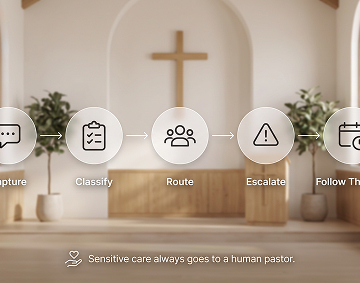
A virtual assistant for pastors works as the always-on front layer of the care pipeline:

Capture. Every call, message, or web chat is answered — 2am included. Prayer requests are recorded word-for-word.
Classify. The assistant recognizes what kind of need this is: routine question, appointment request, prayer request, or crisis.
Route. Requests reach the right person — prayer team, deacon, care pastor — per your routing rules.
Escalate. Crisis indicators trigger immediate live transfer to an on-call contact. No exceptions, no automation past this point.
Follow through. Callbacks get scheduled, reminders sent, and summaries delivered, so nothing depends on a sticky note surviving the weekend.
Missional Agents’ MIRA runs this pattern in production across 250+ call scenarios in 26 ministry categories, with pastoral care requests handled as schedule-a-callback or immediate escalation — never as AI counsel.
Where AI for Ministry Helps Most
AI for ministry helps most at the care touchpoints that are administrative in form but pastoral in consequence:
| Care touchpoint | Without an assistant | With an AI church assistant |
|---|---|---|
| After-hours first contact | Voicemail, often abandoned | Answered warmly, need captured |
| Prayer requests | Scattered across inboxes and memory | Logged verbatim, routed to the prayer team |
| Care appointment scheduling | Phone tag with the office | Booked on the pastor’s care calendar |
| Follow-up after visits | Depends on staff memory | Scheduled and reminded automatically |
| Care-team coordination | Group texts and hallway updates | Summaries and assignments to the right people |
| Resource questions | “Let me find out and call you back” | Answered instantly from the church’s knowledge base |
Every row shares the same shape: the assistant does the remembering; people do the ministering.
AI Chatbot for Church Websites: Helpful or Harmful?
A church AI chatbot belongs on a church website when it is scoped to information and connection — service times, ministries, next steps, “how do I talk to someone” — and clearly labeled as an assistant. An AI chatbot for church websites configured this way is simply the digital equivalent of a well-trained greeter.
Two guardrails keep it healthy. First, honesty: visitors should never wonder whether they are talking to a person. Second, a fast lane to humans: every conversation should offer a real path to a pastor or staff member, prominently, at every turn. A chatbot that traps people in automated loops does pastoral harm precisely because a church website is where people turn in vulnerable moments.
AI Support for Clergy: Preventing Pastor Burnout
AI support for clergy addresses burnout at its documented sources. Barna’s research names immense stress as the top factor pastors give for considering an exit (56%) — and a meaningful share of that stress is the unrelenting operational load stacked on top of genuine care work.
The math of relief is straightforward. Every hour of call handling, scheduling, and follow-up logistics the assistant absorbs is an hour returned to the work that renews rather than depletes — presence, prayer, people. Barna’s January 2026 finding that consideration of quitting has fallen to 24% is encouraging; churches that deliberately reduce operational load on their pastors are working the same problem from the structural side.
Digital tools for churches should be evaluated by exactly this test: does the tool reduce the pastor’s load, or does it add a dashboard to manage?
Digital Tools for Churches: The Shepherd’s Guardrails
Digital tools for churches need explicit guardrails before they touch anything adjacent to care. Ours, in production:
| Safely delegate to the assistant | Never delegate |
|---|---|
| Answering, capturing, routing, scheduling | Grief counsel and crisis conversation |
| Prayer request logging and routing | Spiritual direction and confession |
| Reminders, follow-ups, summaries | Hospital, deathbed, and home visits |
| Information and next-step guidance | Church discipline and reconciliation |
| Crisis detection and instant escalation | Crisis response itself |
One more, on transparency: tell your congregation what the assistant does and why — that it exists so no call for help goes unanswered, and so their pastors spend more hours with people, not paperwork. Framed truthfully, congregations embrace it.
Getting Started with a Church Digital Assistant
Getting started with a church digital assistant takes four deliberate steps:
Map your care pipeline. Where do requests come from, and where do they currently leak? Two weeks of tracking will show you.
Write your escalation rules first. Who is on call, what triggers immediate transfer, what waits until morning. This document precedes any technology.
Pilot on the phone line. Missional Agents offers a 14-day free trial of the Church AI receptionist — plans at $249/month and $699/month with pooled multisite minutes.
Review weekly. Read the call summaries as leadership. You will learn what your community is actually asking — often the most pastorally useful data a church has.
FAQs: Artificial Intelligence for Church Care
Can an AI assistant for pastors handle a crisis call?
An AI assistant for pastors should detect a crisis and escalate immediately to a live on-call contact — nothing more. Well-designed systems recognize crisis indicators and transfer without delay. What they must never do is attempt the crisis conversation themselves. Configure escalation before launch and test it monthly.
Will artificial intelligence for church use replace pastoral staff?
No. Artificial intelligence for church operations absorbs logistics — answering, scheduling, routing, reminding — which shifts staff hours toward care rather than eliminating them. The pastoral tasks that define the role cannot be automated, and churches deploying these tools report redirecting saved hours into ministry.
Is a church digital assistant safe for sensitive information?
It should be, and you should verify. Ask any vendor: where is call data stored, who can access it, is it used to train outside models, and can records be deleted on request. Prayer requests and care notes deserve the same confidentiality discipline as counseling notes.
What is the difference between a church AI chatbot and an AI church assistant?
A church AI chatbot typically handles text conversations on your website; an AI church assistant is the broader category — voice and text, phone and web — handling calls, scheduling, routing, and follow-up. MIRA, for example, is voice-first: it answers the church’s actual phone line.
How do congregations respond to pastoral care automation?
Positively, when it is framed truthfully: the assistant exists so every call is answered and every request reaches a person. Resistance appears when automation is hidden or when people feel handed to a machine in a vulnerable moment — which is why honesty and fast human escalation are non-negotiable design rules.
Shepherds First, Software Second
The role of the AI church assistant in pastoral care is to guarantee the doorway, never to sit in the counseling chair. Every call answered, every prayer request captured, every follow-up kept — so that the shepherding hours go to shepherding.
Missional Agents builds exactly this: digital support staff for churches, with human escalation designed in from the first line of code. Explore AI for churches and start your 14-day free trial — and let your people always reach a person.
Related reading: sermon preparation with AI, and AI as an AI tool for church outreach.