Category: AI Technology
Date Posted : 03-Feb-2026
AI for church sermons works best as a research assistant, not a ghostwriter: it accelerates study, organization, and application brainstorming while the pastor keeps prayer, exegesis, and proclamation fully human. The time pressure is real — the average U.S. Protestant pastor spends 13.8 hours a week on sermon preparation, and 65% work 50 or more hours weekly, according to Lifeway Research. This guide, written from two decades in the pulpit, covers what AI can responsibly do in sermon prep, which tools fit which tasks, and the guardrails that keep the message yours.
What Is AI for Church Sermons?
AI for church sermons is the use of large language models and AI-assisted study software to support the sermon preparation process — research, outlining, illustration hunting, application questions, and editing. It is a category of assistance, not a single product.
The distinction that matters is between preparation and proclamation. AI can compress the mechanical hours of preparation. It cannot pray, cannot know your congregation’s season of grief or growth, and cannot carry the pastoral authority of a shepherd who has done the work. Every use case below assumes that line stays bright.
Is Sermon Writing with AI Theologically Sound?
Sermon writing with AI is theologically sound when AI serves the pastor’s study rather than replacing it — the same standard we have always applied to commentaries, concordances, and sermon libraries. No preacher is criticized for consulting Matthew Henry; the question was never whether help was used, but whether the pastor did the work of understanding, praying, and personally owning the message.
Three tests keep the practice sound. First, the exegesis test: you personally examined the text before asking any tool about it. Second, the conviction test: every sentence preached is something you believe and could defend. Third, the transparency test: if your elders asked how the sermon was built, you could explain it without embarrassment.
Where AI-written sermons fail is wholesale delegation — prompting “write me a sermon on Philippians 4” and preaching the output. That is not preparation enhanced; it is proclamation outsourced.
How Does an AI Sermon Generator Work?
An AI sermon generator produces outlines, drafts, or components from a prompt describing the passage, audience, and goal. Under the hood, a large language model predicts likely text from patterns in its training data — which is precisely why its output needs a pastor’s discernment: it produces plausible text, not vetted theology.
Used well, the workflow looks like this:

You supply the substance. Passage, your exegetical notes, your big idea, your congregation’s context.
The AI supplies structure options. Three outline shapes, transition suggestions, alternate introductions.
You select, correct, and rewrite. The theology, the stories, and the voice are yours.
The AI polishes mechanics. Tightening wording, checking flow, suggesting application questions for small groups.
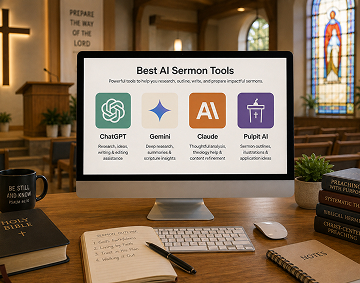
What Are the Best AI Sermon Tools?
| Tool category | Examples | Best for |
|---|---|---|
| AI-assisted Bible study platforms | Logos and similar study suites | Original-language work, cross-references, commentary search |
| General AI assistants | ChatGPT, Claude, Gemini | Outlining, illustration brainstorming, editing, application questions |
| Sermon-specific platforms | Sermonary, Pulpit AI, and similar | Sermon structure templates, prep workflow, repurposing |
| Content repurposing tools | Clip and transcript tools | Turning the preached sermon into devotionals, clips, and posts |
Evaluate any tool against three criteria: does it show sources you can verify, does it keep your data private, and does it save time in preparation without touching conviction in proclamation.
How AI for Pastors Saves Study Time
AI for pastors saves time by absorbing the mechanical layers of preparation, returning hours to prayer, meditation, and people. Against Lifeway’s 13.8-hour weekly average, pastors using AI assistance typically report the biggest savings in three layers:
Research gathering: collating cross-references, historical background, and commentary perspectives in minutes instead of hours.
Structural drafting: generating outline options to react against, which is faster than staring at a blank page.
Editing and support material: discussion guides, slide text, and summaries produced from your finished manuscript.
Even a conservative three-to-four-hour weekly saving, multiplied across a year, returns roughly four full work-weeks to a pastor — time Lifeway’s data suggests is currently squeezed from prayer and family, not from leisure.
Using a Sermon Outline Generator Wisely
A sermon outline generator is most useful after your own study, not before it. Feed it your completed exegesis and big idea, then ask for structural options — deductive, inductive, narrative — and treat each as a draft to argue with.
Used before study, an outline generator quietly sets your interpretation for you; the tool’s reading of the text becomes your sermon’s skeleton before you have wrestled with the passage yourself. Sequence is the safeguard: text first, tool second.
Should You Generate Sermons with AI?
You should not generate sermons with AI end-to-end, but you should let AI carry specific, bounded tasks. The dividing line:
| Safe to delegate to AI | Keep fully human |
|---|---|
| Background research and cross-references | Prayer and personal study of the text |
| Outline and structure options | Interpretation and theological judgment |
| Illustration brainstorming (verify every fact) | Personal stories and congregational application |
| Editing, titles, and transitions | The conviction behind every claim |
| Discussion guides and slide text | Delivery and pastoral presence |
One operational rule from our own standards at Missional Agents: verify everything. AI tools fabricate quotes, statistics, and even Bible references with complete confidence. Every citation that reaches the pulpit gets checked against a primary source.
A Weekly Workflow with Church Sermon AI Tools
Church sermon AI tools fit naturally into a Monday-to-Sunday rhythm:
Monday — Text first. Read the passage repeatedly. Journal observations. No AI yet.
Tuesday — Research and structure. Use AI to organize research, identify cross-references, and generate possible sermon structures after completing your own study.
Wednesday — Develop the message. Select, correct, and rewrite the structure so the theology, stories, and voice remain your own.
Thursday — Polish the message. Use AI for editing, transitions, clarity, discussion questions, and supporting material.
Friday — Verify everything. Check citations, statistics, quotations, Scripture references, and theological claims against reliable sources.
Sunday — Proclaim. Put the tools aside and preach the message you have personally studied, prayed through, and prepared for your congregation.
FAQs: AI Tools for Preachers
What is the best sermon preparation software with AI?
The best sermon preparation software depends on your bottleneck: study platforms like Logos excel at exegetical research, general assistants like ChatGPT or Claude excel at structure and editing, and sermon-specific platforms bundle prep templates with repurposing. Most pastors get the most value from one study platform plus one general assistant.
What is Sermon Spark AI and tools like it?
Sermon Spark AI and similar tools are prompt-driven sermon helpers that generate outlines, illustrations, and draft segments from a passage and topic. Treat their output as raw material for your own study process — useful for ideation, never a substitute for exegesis and prayer.
Can I generate sermons with AI ethically?
Generating complete sermons with AI and preaching them as your own is widely viewed as a breach of pastoral integrity — comparable to preaching another pastor’s manuscript without attribution. Generating components (outlines, background research, editing passes) under your own study and judgment is an ethical extension of tools pastors have always used.
Do AI tools for preachers fabricate information?
Yes. Large language models regularly invent quotes, statistics, historical claims, and even scripture references. Every fact an AI supplies must be verified against a primary source before it reaches the pulpit. This is the single most important operating rule for AI in sermon preparation.
Will my congregation know I used AI?
They will know if the sermon stops sounding like you — generic phrasing, borrowed conviction, no local texture. They will not object to AI compressing your research any more than they object to commentaries. Preserve your voice, your stories, and your application, and the technology stays where it belongs: invisible, in the study.
Prepare Better Sermons — and Get Your Week Back
AI for church sermons will not make anyone a preacher. What it can do is return a meaningful share of the 13.8 weekly preparation hours to the work only a shepherd can do — prayer, people, and proclamation.
Missional Agents builds AI that serves churches the same way: as digital support staff, never a replacement for ministry. While your study gets faster, our Church AI receptionist makes sure no call, prayer request, or first-time guest slips by while you are in the Word. Explore AI for churches and start a 14-day free trial at missionalagents.com.